Tuesday, twenty to eleven. You are twenty files deep into the assembly of a dosing unit: three parts modified, two drawings open beside them, and a tricky fit half solved. Then the project lead walks in: a rush job has to happen right now, everything else can wait. And the job really can wait. But what do you do with those twenty open files and everything you just knew about them?
Normally a switch like that means: save, close everything, and reconstruct in two days what you had open and why. There is a smarter way. In this article you will read how Thundercad lets you park a complete working session in one go, so you later resume work in Inventor with exactly the session you left behind. Plus the four situations where that is worth gold, from rush orders to Friday afternoon.
The real price of an interruption
Closing files is not the problem; that is a minute of work. The damage sits in the coming back. Which parts did you have open, and why those? Did that one drawing still belong to this job, or to the previous one? You search through recent files, open the main assembly, wait for everything to load, open the individual parts you had next to it, and meanwhile try to reconstruct where exactly you left off.
Run the numbers with an assumption you can adjust yourself: say that finding, reopening and getting back into it together cost twenty minutes, and that you make three of those hard switches per week. Then an hour leaks away every week to work you had already done. On a team of four engineers that is a full working day every two weeks, without anyone doing anything wrong. The switch itself is rarely avoidable; the reconstruction is.
Parking and loading back: how it works
Quick save: capture the whole session in one go
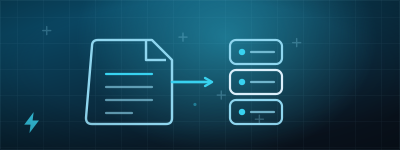
With Quick save you record in a single action which documents are open at that moment: the assembly, the individual parts, the drawings alongside. Not a list you keep on a sticky note, but a parking spot for the complete working session. After that you close everything with peace of mind and start on something else.
Important to keep sharp: parking is about the session, not the content. You save changes to your models the way you always do, or check them in through Vault following your team's agreements. Quick save then remembers what you had open, so you no longer have to.
Quick load: continue where you left off
When you come back to the work, this afternoon or next week, Quick load brings the parked session back in one go: the same files, exactly as you left them. No hunt through folders, no doubt about whether you have everything. Your first five minutes are about that half-solved fit again, not about the question which files belonged with it.
Four moments when parking is worth gold
Some switches announce themselves, others simply happen to you. In these four situations a parked session pays off immediately:
- The rush order in between. Park your current work, give the rush job all the room it needs and load your session back afterwards as if nothing happened. How to steer such an order through the department without casualties is a story of its own; you can read it in Rush orders: moving fast without sacrificing quality.
- The project switch. Wrapping up project A this morning, continuing with project B this afternoon? Park A as you walk away and load the session back tomorrow; you are right back in the middle of it instead of clicking around for a quarter of an hour first.
- Friday afternoon. Park before the weekend and start Monday morning without the usual startup confusion. The first coffee is then about the work itself, not about the question where you were.
- The unexpected absence. Nobody who calls in sick thinks about open files. If parking is part of your routine, you simply pick up your own session after a week instead of reconstructing your work from memory.
Every switch without parking easily costs a quarter of an hour of searching and reopening. Quick save and Quick load are part of Thundercad, along with the rest of the toolbox for Inventor.
Try 30 days freeWhat parking is not
To set the right expectations: Quick save is not a replacement for saving, version management or checking in to Vault. It parks your session, not your changes; those you keep the way you always have. It is not a backup of your files either. Think of it as the floor plan of your workbench: where everything was when you walked away. The contents of the cabinets you manage with your normal saving and data management routine.
Parking does not make the opening itself any faster either: a heavy assembly remains a heavy assembly. The gain is in no longer searching and no longer forgetting. If you want to work on the loading time as well, read Opening large assemblies faster (and closing them cleanly again); the two reinforce each other.
Make it a fixed ritual
A tool only works once it becomes a habit, and this habit is small enough to stick. Two fixed moments are enough: park at the end of the working day and right before every planned switch. For the unplanned ones there is one rule: park first, then switch. It takes seconds, and it is exactly the moment you will later be glad you did.
After a few weeks the biggest effect shows up somewhere unexpected: you dare to stop more easily. An interruption no longer feels like throwing work away, because going back costs nothing. That makes you more flexible towards colleagues and planning, without your own work paying the price.
Frequently asked questions
Does parking work with large assemblies too?
Especially there. The more files you have open, the bigger the chance of missing a few when reopening by hand. The loading itself takes as long as it takes, but the searching and reassembling of your session disappears completely.
What happens to changes I had not saved yet?
Parking does not replace saving: save your work the way you are used to and park the session afterwards. Quick save remembers which documents belong to your session; the content of those documents you manage with your normal saving and data management routine.
Can I try Quick save and Quick load without obligation?
Yes. Both tools are part of Thundercad and you can try the toolbox free for 30 days. Park your session every Friday afternoon during that month, and by Monday morning you will know exactly what it saves you.